Introduction
Introduction

When I was two years old, my brother, Gregory, was born. I recently looked back on some old home videos and was surprised how nonplussed I was when my brother would struggle with sensory input and changes to routine. By the time he was six years old, he officially was diagnosed with autism. Back in the early 1990's, autism was not as prevalent and well-known as it is today and many of Greg's teachers didn't know how to handle his behaviors (he was placed in a general ed setting, but exhibited behaviors that would disrupt the class). My mother made the decision to take him out of public school and home school him from 5th grade all the way through his senior year of high school, in which he thrived academically and behaviorally, but did miss out on the social aspects of being around other peers.

All this being said, I really wanted to do my "Choose Your Own Topic" on autistic representation in children's books and picture books since, growing up, there was a scarcity of materials available. I also wanted to elaborate further and find children's book authors and illustrators with autism themselves. Even today when I ask my brother about when he was younger, he always answers with, "I did a lot of weird things because I was flawed;" I wonder if there were more books with autistic representation when we were growing up if he would still feel the same way.
Why is Representation of Autism in Children's Literature Important?
Dr. Rudine Sims Bishop outlines the importance of representation for children in literature by making the analogy to mirrors, windows, and sliding glass doors:
"Books are sometimes windows, offering views of worlds that may be real or imagined, familiar or strange. These windows are also sliding glass doors, and readers have only to walk through in imagination to become part of whatever world has been created or recreated by the author. When lighting conditions are just right, however, a window can also be a mirror. Literature transforms human experience and reflects it back to us, and in that reflection we can see our own lives and experiences as part of a larger human experience. Reading, then, becomes a means of self-affirmation, and readers often seek their mirrors in books" (n.d.).
Children with autism need to see themselves represented in literature so that they can be shown that they belong and matter in the world. Stories that normalize people with autism instead of treating them as a "burden" or "tragic cases" is so important to the conversation of representation. Authors that have gone through life with autism are able to put into words and illustrate what their experiences have been like so that empathy and compassion can grow for people not familiar with autism; on the other end, children with autism can feel seen, heard, and know that there's shelf space for them.
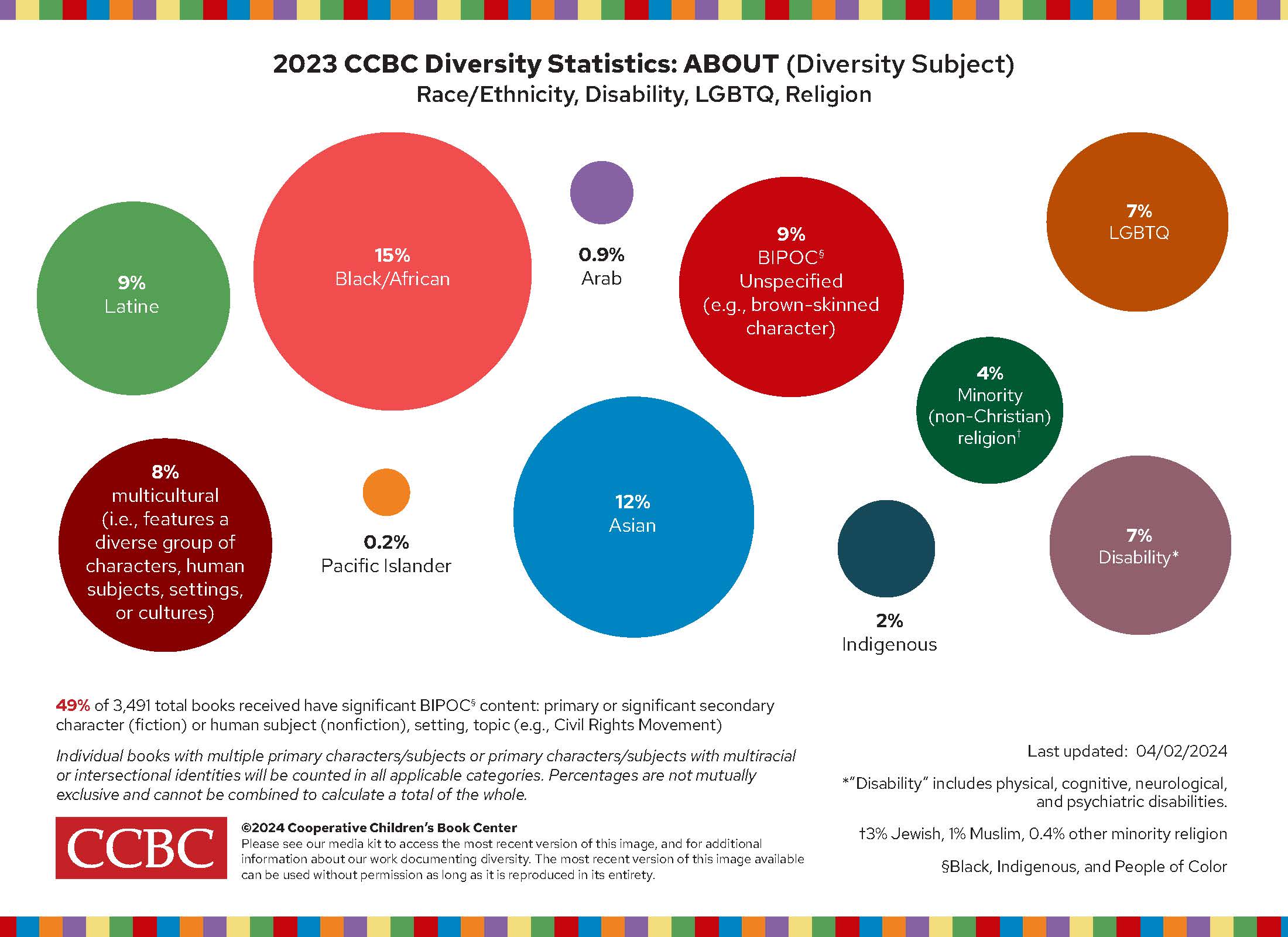
There are so many more stories focused on normalizing people with autism than just the savant character from "Rain Man." In a 2019 study by the Cooperative Children's Book Center, "only 3.4% of children's books have disabled main characters" compared to the CDC's statistics showing that 26% of Americans have a disability (CCBlogC, 2020). In a more recent 2023 study, CCBC documented an increase in disability representation (includes physical, cognitive, neurological, and psychiatric disabilities) to 7% (Dickinson, 2024).
Comments
Post a Comment